

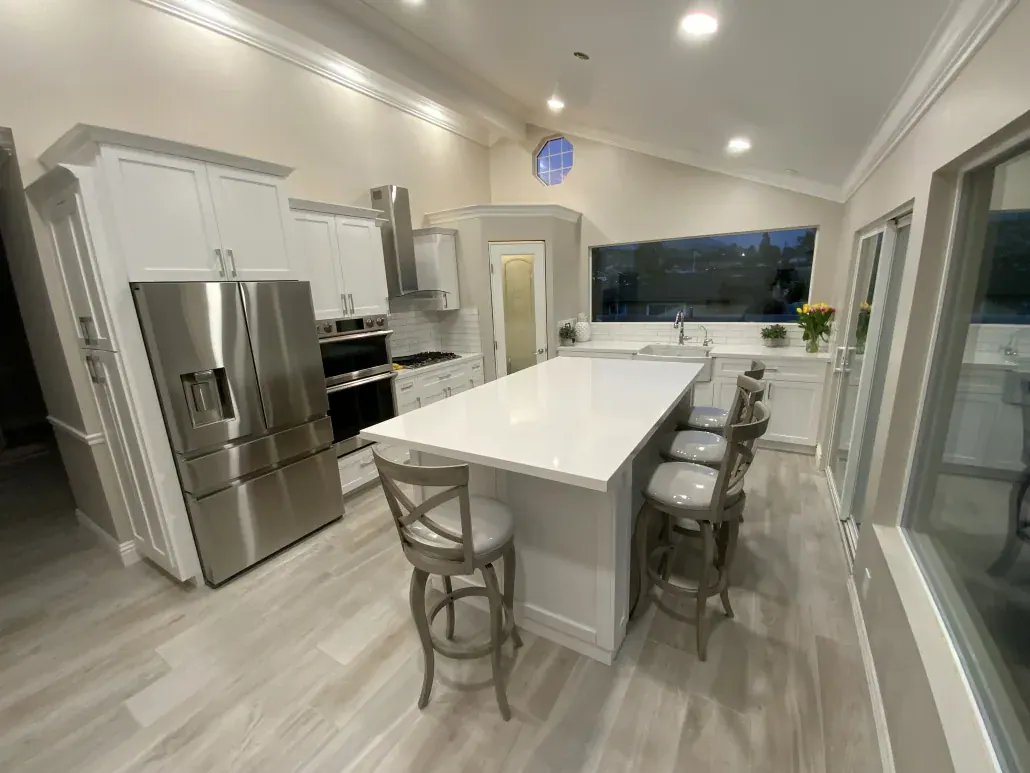
Kitchen Remodeling
Kitchen Cabinets and Countertops
New cabinets and counters change a kitchen more than anything else for the money. Here is how we help you choose them, and how we install them so the doors line up and the seams land in the right places.


Kitchen Cabinets & Countertops
Cabinets and counters are usually the two biggest lines on a kitchen estimate, and they are the parts of the room you touch every day. A cabinet and counter replacement can also be a lighter project than a full remodel: if the sink, range and refrigerator stay where they are, the plumbing and gas stay put, and the kitchen can be back in use much sooner.
The choices come down to how the boxes are built, how the doors and drawers are made, what the counter is made of, and how it all goes in. This page walks through those decisions the way we talk about them at a kitchen table, with the trade-offs we see on real jobs.
Stock, semi-custom or custom cabinets
Stock cabinets come in fixed sizes, usually in 3-inch steps, and a limited range of door styles and finishes. They are the least expensive and the quickest to get. Filler strips close the gaps where the sizes do not fit the wall exactly. Semi-custom lines offer more sizes, depths, finishes and interior options such as pull-outs and drawer organizers. Custom cabinets are built to the room, which matters in older houses where walls are out of square or the ceiling height varies.
Box construction matters more than the door style. Plywood boxes hold screws and resist water better than particleboard, and full-extension, soft-close drawer slides make deep drawers usable. Under the sink, where leaks happen, a moisture-resistant floor or a drip tray saves a cabinet later.
Drawers instead of doors
Deep drawers for pots and dishes in the base cabinets are easier to use than shelves you have to kneel to reach.
Uppers to the ceiling
Running upper cabinets to the ceiling adds storage and removes the dust shelf above them.
Pull-outs and organizers
Trash pull-outs, spice drawers and corner solutions cost extra but change how the kitchen works every day.
Quartz or granite
Quartz is an engineered surface made mostly of ground stone bound with resin. It never needs sealing, resists stains and comes in consistent patterns, including convincing marble looks. The resin can be damaged by very hot pans, so trivets matter, and some colors can yellow in strong direct sun.
Granite is natural stone cut from a quarry, so every slab is different. It handles heat well and lasts for decades, but it is porous and should be resealed every so often. Picking your actual slab at the fabricator's yard is part of the process. Butcher block is a warmer, less expensive option for an island or a section of counter, with regular oiling as its upkeep.
In most kitchens either stone works. The decision usually comes down to the look you want, how much maintenance you will do, and the price of the specific slab, which varies more within each material than between them.
How the install order affects the result
Cabinets go in first, and they have to be level and flat across their tops, or the stone will rock and crack. Older floors are rarely level, so we shim and scribe each box to the room. Then the countertop fabricator measures the installed cabinets, a step called templating, and cuts the slabs to fit. Measuring from installed cabinets rather than drawings is what keeps the overhangs even and the seams tight.
We plan seam locations with the fabricator so they fall away from the sink and cooktop, and we confirm the sink model, faucet holes and cooktop cutout before templating. The backsplash goes in after the counters are set.
From our clients
Real Google reviews from LE Construction clients, quoted word for word.
EXCELLENT
5.0 out of 5, based on 17 Google reviews
Pick materials with someone who installs them
We will measure your kitchen, talk through cabinet lines and stone, and give you a written price for the swap.
Kitchen Cabinets & Countertops: FAQs
Can I replace cabinets and counters without a full kitchen remodel?
Yes, if the layout works and the plumbing, gas and electrical can stay where they are. We remove the old cabinets and counters, repair the walls and floor behind them, install the new cabinets, template and set the counters, and reconnect the sink and appliances. Flooring that did not run under the old cabinets may need attention. This is often a much shorter project than a full remodel.
How long after cabinets go in do the counters arrive?
The fabricator templates once the cabinets are installed, then cuts and polishes the slabs, which commonly takes one to two weeks depending on the shop and the material. During that gap the kitchen has cabinets but no counter or sink. We schedule a temporary sink if you need one and tell you the timeline up front.
Does quartz really never need sealing?
Quartz is non-porous because of its resin binder, so it does not need the periodic sealing granite does. It still needs reasonable care: very hot pans can scorch or crack the resin, and harsh chemicals can dull the finish. Mild soap and water are usually all it needs.
Is cabinet refacing an option instead of replacing?
Refacing replaces doors, drawer fronts and the visible face of the boxes while keeping the existing cabinet boxes. It can work when the boxes are sound and the layout is fine. If the boxes are water damaged, poorly built or in the wrong places, replacing them makes more sense. We look at the boxes before recommending either.
Related services
Kitchen Remodels near you
- Santa Paula, CA5–12 min from Santa Paula
- Oxnard, CA20–40 min from Santa Paula
- Carpinteria, CA38–60 min from Santa Paula
- Saticoy, CA12–20 min from Santa Paula
- Ventura, CA15–35 min from Santa Paula
- El Rio, CA15–25 min from Santa Paula
Related pages
- Kitchen Remodeling (overview)
- Open-Concept Kitchens & Wall Removal
- Small Kitchen Remodels
- Kitchen Remodel Cost in Ventura County (2026–27 Price Guide)
Cost guide
- Best Time of Year to Remodel in Ventura County (and When to Book)
Seasonal
- Cabinet Refacing vs Replacing: Which Saves More?
Costs
- How to Check a Contractor's License in California (CSLB Lookup, Step by Step)
Permits