

Concrete Work
Concrete Driveways
Replacing a cracked driveway or pouring a new one: compacted base, the right thickness, reinforcement, control joints and a permitted approach at the street.


Concrete Driveways
A driveway takes more abuse than any other slab around the house: the weight of cars every day, oil, sprinkler water, tree roots, and the occasional delivery truck. Most driveway failures come from below. A base that was never compacted, a slab poured too thin, or joints placed too far apart lead to the cracks and sunken sections that send people looking for a contractor.
We pour driveways under our C-8 Concrete license. Replacing a driveway is usually a short project once it is scheduled: removal, base preparation, forming and the pour. The longer wait is the curing time before you can park on it.
What goes under the concrete
After the old concrete is broken out and hauled away, the subgrade is shaped and compacted. Soft spots are dug out and replaced. Base rock goes down and is compacted in layers. On clay soils, which swell and shrink with moisture, the base and drainage get extra attention.
Reinforcement is set on supports so it sits in the middle of the slab rather than on the ground. Rebar or welded wire both work when they are positioned correctly; steel lying in the dirt does almost nothing.
Thickness and joints
Driveways are typically poured at least 4 inches thick for passenger cars, and thicker where heavier vehicles park or the soil is poor. Control joints are cut or tooled at regular intervals, commonly about 8 to 12 feet apart for a 4-inch slab, so the shrinkage cracks every slab develops follow straight lines instead of wandering across it. Expansion joints separate the driveway from the garage slab, walks and the street approach.
Broom finish
The standard, slip-resistant finish for driveways, and the least expensive.
Exposed aggregate
Stones exposed at the surface for texture and traction.
Color and borders
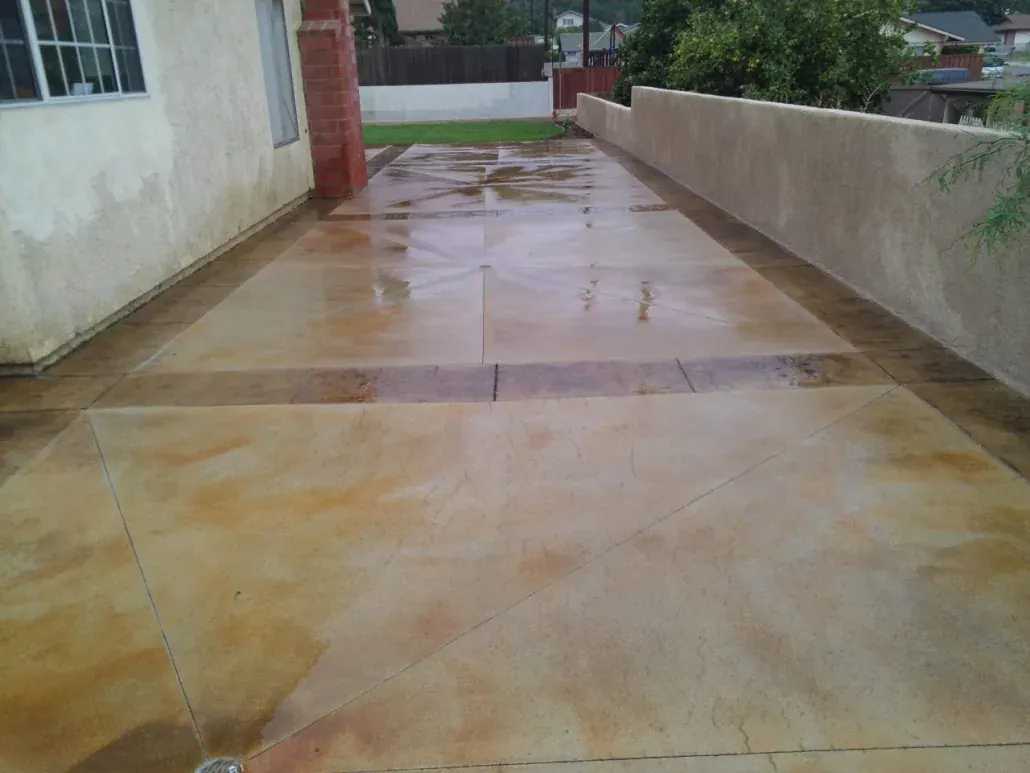
Integral color or a stamped or stained border to dress up a plain slab.
The approach at the street
The section between the sidewalk and the street, called the approach, is usually in the public right-of-way. Replacing or widening it typically needs an encroachment permit from the city or the County, and it is built to their standard details. We apply for the permit and schedule the city inspection.
From our clients
Real Google reviews from LE Construction clients, quoted word for word.
EXCELLENT
5.0 out of 5, based on 17 Google reviews
A driveway built from the base up
We will measure, check the base and the approach, and give you a written price.
Concrete Driveways: FAQs
How much does a concrete driveway cost?
The main factors are size, thickness, demolition and haul-off of the old driveway, base work, finish and any approach permit. A plain broom-finish replacement costs much less than a colored or stamped driveway with a new approach. We measure and give you a written, line-item price.
How long before I can drive on new concrete?
Walking is usually fine after a day or two. Passenger cars should typically wait about a week, and heavy vehicles longer. Concrete continues to gain strength for about a month. We give you specific dates based on the mix and the weather.
Should I repair or replace my cracked driveway?
Small, tight cracks can be sealed. Sections that have sunk, heaved from roots or broken into pieces usually need to be removed and replaced, sometimes just those panels between joints. If the whole driveway is failing, replacement is the long-term fix. We look and tell you which you need.
Does a driveway replacement need a city permit?
The part on your property often does not need a building permit, but the approach at the street usually needs an encroachment permit from the city or County. Changing the curb cut or widening the driveway always involves the city. We check the rules for your address.
Concrete near you
- Santa Paula, CA5–12 min from Santa Paula
- Oxnard, CA20–40 min from Santa Paula
- Carpinteria, CA38–60 min from Santa Paula
- Ventura, CA15–35 min from Santa Paula
- Fillmore, CA15–25 min from Santa Paula
- Somis, CA22–35 min from Santa Paula
Related pages
- Concrete Work (overview)
- Concrete Patios & Stamped Concrete
- Retaining Walls
- Foundations
- Concrete Driveway Cost in Ventura County (Plus Patios & Stamped Concrete)
Cost guide
- Concrete Patio vs Pavers vs Stamped Concrete (Ventura County Prices)
Costs
- Covered Patio Ideas for Coastal & Inland Ventura County
Design
- Rebuilding After the Mountain Fire: Permits, Fee Waivers & Timeline
Seismic & Fire