

Concrete Work
Concrete Patios and Stamped Concrete
Patios, walkways and side yards in broom finish, color, stain or stamped patterns, sloped away from the house and jointed so cracks stay where they belong.


Concrete Patios & Stamped Concrete
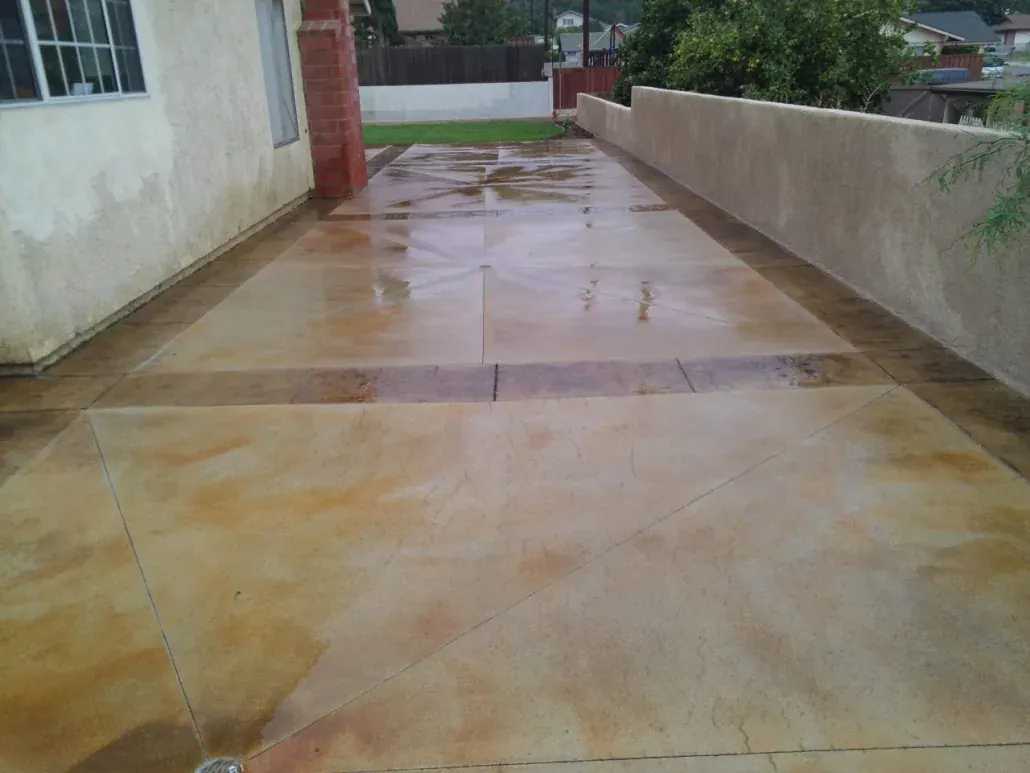
A concrete patio is the base for most outdoor living: the floor under the dining table, the slab under the patio cover, the path to the side gate. It can be plain and practical or finished to look like stone, tile or wood. The stained side yard patio and curved entry steps in our gallery show what color can do for a plain slab.
Whatever the finish, a patio has two jobs: send water away from the house and stay flat. That comes from base preparation, slope and joints, which are the same whether the surface is broom-finished or stamped.
Finish options
Broom finish is the simplest and most slip-resistant. Integral color tints the concrete throughout, so chips do not show gray. Acid or water-based stains add variegated color to cured concrete. Stamped concrete is pressed with patterned mats while it is still workable, often with a release powder that adds a second color, to look like flagstone, slate, brick or wood plank.
Broom finish
Least expensive, good traction, easy to repair.
Color and stain
Warmer than gray concrete, with low added cost.
Stamped
Stone or brick looks for less than the real material, with resealing every few years.
Stamped concrete or pavers
Stamped concrete costs less than many paver installations and has no joints for weeds. It is still a slab, though, so cracks can happen, and repairs are hard to blend. Pavers cost more to install but can be lifted and reset if the ground moves or a pipe needs repair. Near trees with surface roots, pavers can be the better choice.
Slope, joints and sealing
Patios slope away from the house, enough to drain without feeling tilted. Where a patio meets the house, it sits below the weep screed at the bottom of the stucco so water cannot wick into the wall. Control joints are placed in a pattern that suits the shape, and on stamped concrete they are hidden in the pattern where possible. Stamped and colored patios are sealed after curing and resealed periodically.
From our clients
Real Google reviews from LE Construction clients, quoted word for word.
EXCELLENT
5.0 out of 5, based on 17 Google reviews
Pour the floor of your outdoor room
Tell us the size and the look you want. We will check the slope and drainage and give you a written price.
Concrete Patios & Stamped Concrete: FAQs
How much does a stamped concrete patio cost compared with plain?
Stamping adds labor, color and sealer, so it costs noticeably more than a broom-finish slab of the same size, but often less than natural stone or many paver installations. Complex patterns and multiple colors cost more. We can price plain and stamped options side by side.
Is stamped concrete slippery?
It can be when wet, especially with a glossy sealer. Adding a grit additive to the sealer and choosing patterns with more texture help. Around pools and on slopes, we recommend those steps or a broom-finish border.
How often does stamped concrete need sealing?
Typically every few years, depending on sun exposure and traffic. Resealing protects the color and the surface. When the finish looks dull or water no longer beads, it is time.
Can you pour a new patio right against the house?
Yes, with the right details. The patio slopes away from the house and stays below the weep screed at the base of the stucco, with an expansion joint against the foundation. Burying the weep screed is a common cause of stucco and framing damage, so we set the height carefully.
Concrete near you
- Santa Paula, CA5–12 min from Santa Paula
- Oxnard, CA20–40 min from Santa Paula
- Carpinteria, CA38–60 min from Santa Paula
- Ventura, CA15–35 min from Santa Paula
- Fillmore, CA15–25 min from Santa Paula
- Somis, CA22–35 min from Santa Paula
Related pages
- Concrete Work (overview)
- Concrete Driveways
- Retaining Walls
- Foundations
- Concrete Driveway Cost in Ventura County (Plus Patios & Stamped Concrete)
Cost guide
- Concrete Patio vs Pavers vs Stamped Concrete (Ventura County Prices)
Costs
- Covered Patio Ideas for Coastal & Inland Ventura County
Design
- Rebuilding After the Mountain Fire: Permits, Fee Waivers & Timeline
Seismic & Fire